Part 5 - Land Use Districts / Commercial/Industrial
RCC
This part outlines specific regulation that applies to the City’s Land Use Districts.
5.10 RCC - Regional Commercial District
- Application
This section applies to the areas designated as Regional Commercial (RCC) District on the Land Use District Map, Schedule A of this Bylaw. - Purpose
- Provide a high-quality Commercial District for the sale of a wide variety of goods and services to the community and the surrounding region;
- Require that developments are designed to provide a safe, pleasant, and pedestrian-friendly environment; and
- Require that development is effectively connected to surrounding developments for all means of transportation.
- Permitted and Discretionary Uses
| Permitted Uses | Discretionary Uses | |
|---|---|---|
| (i) | a) Animal Grooming means a development entirely located within an enclosed building for the grooming of a domestic pet. This does not include animal service. | b) Animal Health means a development used for the medical care, treatment, and incidental overnight accommodation of a domestic pet, but not livestock. Typical development includes a veterinary clinic or animal hospital, not including animal service. |
| (ii) | a) Art Gallery/Studio means a public or private facility which is used for the production or sale of or as a repository of works of individual art pieces not mass produced, including paintings, photographs, drawings, etchings, pottery, or sculptures. | b) Automotive (Sales) means a development used for the sale of a vehicle, recreation vehicle, or recreation equipment and may include an automotive (service) component. Typical development includes a car or motorcycle dealership, not including automotive (specialty) or heavy vehicle and equipment (sales and service). |
| (iii) | a) Catering Service means a development where food and beverages, to be served off the premises, are prepared for sale to the public. which uses up to three vehicles | b) Automotive (Service) means a development used for the service and repair of a vehicle, recreation vehicle, or recreation equipment or their components. Typical development includes automotive painting, collision repair, and service shops, not including automotive (specialty) or heavy vehicle and equipment (sales and service). |
| (iv) | a) Equipment Service means a development that provides repair services for household goods, equipment, and appliances. Typical uses include radio, television, and appliance repair shops, and furniture refinishing and upholstery shops. | b) Automotive (Specialty) means a development used for the sale and installation of accessory components for a vehicle, recreation vehicle, or recreation equipment. Typical development includes vehicle wrap, window tint, decal shop, audio or visual equipment, not including automotive (sales), automotive (service), and heavy vehicle and equipment (sales and service). |
| (v) | a) Establishment (Brew Pub) means a development where food and beverages are prepared and served for consumption by the public, and alcoholic beverages, excluding spirits, are brewed on the premises as an accessory use. This use may include accessory retail sales on or off the premises. This use does not include establishment (drinking) or establishment (restaurant). | b) Broadcasting Studio means a development used for the production or broadcast of audio or visual programming, including radio, music, television, and movie programs. |
| (vi) | a) Establishment (Drinking) means a development licensed to serve alcoholic beverages for consumption on the premises, and may include up to 10 video lottery terminals as an accessory use. This use does not include establishment (brew pub) or establishment (restaurant). | b) Car Wash means a development used for the cleaning of vehicles. |
| (vii) | a) Establishment (Entertainment) means a development where live performances or motion pictures are shown. Typical development includes a cinema, theatre, or music hall, not including establishment (adult). | b) Conference and Banquet Facility means a development that provides auditorium, banquet, exhibition, gymnasium, meeting, or seminar facilities. This use does not include establishment (gaming). |
| (viii) | a) Establishment (Restaurant) means a development where food and beverages are prepared and served for consumption by the public. Typical development includes restaurants, fast-food restaurants, and takeout restaurants, not including establishment (brew pub) or establishment (drinking). | b) Construction Service means a development used to provide landscaping, electrical, plumbing, heating, painting, woodworking, or similar contractor services to households or to general contractors. This use does not include equipment rental. |
| (ix) | a) Government Service means a development where municipal, provincial, or federal government services are provided directly to the public, and includes development required for the public protection of persons or property. Typical development includes a police station, fire station, courthouse, post office, transit service, public museum, library, school board or social services office. | b) Daycare Facility means a development used to provide care and supervision to seven or more children or adults. Typical development includes daycare centres, preschools, kindergartens, and adult support programs. |
| (x) | a) Group Home means a development consisting of the use of a residential dwelling for care and supervision of occupants. A group home is intended to provide room and board for occupants requiring specialized or personal care, guidance, or supervision. The residential character of the development shall be primary, with the occupants living together as a single housekeeping group, and using cooking facilities shared in common. This does not include transitional accommodation. | b) Drive-through means part of a development designed to serve customers remaining in their vehicles. |
| (xi) | a) Health Service means a development used for the provision of physical and mental out-patient health care, and social or counselling services. Services may be of a preventative, diagnostic, treatment, therapeutic, rehabilitative, or counselling nature. Typical development includes medical and dental offices, health and physiotherapy clinics, or massage therapy clinics. | b) Dwelling or Dwelling Unit means a self-contained residence comprising cooking, washroom, living, and sleeping facilities with a separate private entrance from the exterior of a building or from a common hall, lobby, or stairway inside a building, but does not include any part of a hospital, hotel, or recreation vehicle. above a non-residential use |
| (xii) | a) Hotel means a commercial development used to provide temporary sleeping accommodation to the public, and which may also contain a restaurant, drinking establishment, or conference and banquet facility. Typical development includes a hotel, hostel, or motel. | b) Equipment Rental means a development used to rent household equipment or light machinery to the public. This use does not include fleet service. |
| (xiii) | a) Park means land that is intended to be used by the public for active and passive recreation, or general enjoyment. | b) Establishment (Gaming) means a development that provides patrons the opportunity to engage in games of chance and skill. Typical development includes a racetrack with a betting facility (either on-site or off-site), a casino, and a bingo hall. |
| (xiv) | a) Personal Service means a development used to provide services related to the care and appearance of an individual, including the cleaning and repair of clothing, but does not include health service or establishment (adult). Typical development includes dry cleaner, hair salon, tanning salon, laundromat, tailor, shoe repair, and aesthetician services. | b) Home-Based Business (Level Two) means an Accessory Development in a dwelling unit or an accessory building, for a business that is operated by a permanent resident of the dwelling unit, and may include one employee who does not reside on the property. This use does not include animal service, automotive (service), automotive specialty, fleet service, or a dry cleaner. |
| (xv) | a) Professional Office means an office use providing professional services. Typical development includes offices providing accounting, architectural, employment, engineering, insurance, investment, legal, real estate, planning, secretarial, broadcasting studios, and travel agent services. This use does not include health service or government service. | b) Public Utility Building means a development in which the owner or operator of a public utility maintains or houses any operation in connection with the distribution of a public utility, but does not include any development for the production of electric power or gas. |
| (xvi) | a) Recreation (Indoor) means a development used for sports or recreation within an enclosed building. Typical development includes a health and fitness club, swimming pool, bowling alley, amusement arcade, athletic field, rink, or court, not including conference and banquet facility or establishment (gaming). | b) Religious Assembly means a development used for worship and related religious, philanthropic, or social activities, and includes accessory rectories, manses, meeting rooms, and food preparation and service facilities. Typical uses include churches, chapels, mosques, temples, synagogues, parish halls, convents, or monasteries. |
| (xvii) | a) Retail (General) means a development for the retail sale of a wide range of consumer goods and services with a floor area less than 4,000.00 m² (43,055.64 sq. ft.), but does not include a warehouse store (retail). Typical development includes a grocery store, variety store, clothing store, sporting goods store, furniture store, jewelry store, financial institution, pharmacy, or liquor store. | b) Retail (Cannabis) means a development used for the retail sale of cannabis that is authorized by provincial or federal legislation. This does not include a cannabis production and distribution facility or a cannabis production and distribution facility (micro). |
| (xviii) | a) Service Station means a development used for the sale of vehicle fuels, electric charging, lubricating oils, and other automotive fluids and incidental goods. | b) Accessory means subordinate, incidental to, and exclusively devoted to a principal use or principal building. Development to any Permitted Use or Discretionary Use |
| (xix) | a) Shopping Centre means a development comprised of three or more separate commercial or mixed-use buildings that operate as a unit and share a common parking area. | |
| (xx) | a) Supportive Living Accommodation means a development, in a multiple-dwelling or sleeping-unit form, that provides residents with access to on-site professional care and daily living support, and is recognized, authorized, licensed, or certified by a public authority. | |
| (xxi) | a) Warehouse Store (Retail) means a development with a gross floor area of 4,000.00 m² (43,055.64 sq. ft.)or greater for the wholesale or retail sale of goods. Typical development includes a large grocery store, big box store, or home improvement store. |
- Application Requirements
- In addition to the application requirements of section 2.4 of this Bylaw, an Applicant for a
Development Permit means the document issued by the Development Authority or by Council in a Direct Control District under this Bylaw or any previous Land Use Bylaw, and includes any plans or conditions of approval. within the RCC District must submit, to the satisfaction of the
Development Authority has the same meaning as set out in the MGA.:
- An overall conceptual site development plan for the area designated as RCC, or, if the Applicant is only developing a portion of the subject area, a site development plan in relation to the portion to be developed, in which plan the Applicant has also illustrated how the development will be integrated with the area designated as RCC;
- The overall conceptual site development plan, considered to be non-binding, must identify the proposed building types and locations, development phasing, vehicular and pedestrian routes, Amenity Area means any portion of a development site intended for active or passive recreation, including landscaped areas, patios, and balconies., and Sign means an accessory device or structure erected or placed for the purpose of providing directions or information, and includes copy. This does not include a wall mural.; and
- Details regarding the architectural guidelines proposed for the development, including design drawings illustrating the colour scheme and building materials.
- In addition to the application requirements of section 2.4 of this Bylaw, an Applicant for a
Development Permit means the document issued by the Development Authority or by Council in a Direct Control District under this Bylaw or any previous Land Use Bylaw, and includes any plans or conditions of approval. within the RCC District must submit, to the satisfaction of the
Development Authority has the same meaning as set out in the MGA.:
- Building Height
- The maximum building height is 72.18 ft..
- Setbacks
- Front yard
Setback means the distance from the foundation wall of a building to the property line at right angles or radially to it. Where there is no foundation wall, the distance shall be measured from the exterior wall at grade, not including cantilevered wall sections or architectural projections.
- The minimum front yard building setback is 19.65 ft..
- Side yard setback
- The minimum side yard building setback is:
- 11.48 ft. adjacent to a Non-Residential District includes a Commercial District, Industrial District, Special District, and any non-residential component of a Mixed-Use District. or use; and
- 19.65 ft. adjacent to a Residential District includes the LDR, SLR, LLR, FBR, MDR, HDR, MID (areas A and B), and ICC (Area A) Districts. or use.
- Notwithstanding section (A), a 0.00 m side yard building setback may be approved when traffic circulation or deliveries would not be adversely affected.
- The minimum side yard building setback is:
- Rear yard setback
- The minimum rear yard building setback is:
- 0.00 m adjacent to a Non-Residential District or use; and
- 19.65 ft. adjacent to a Residential District or use.
- The minimum rear yard building setback is:
- Notwithstanding sections (a) through (c), the Development Authority may reduce the building Setback means the distance from the foundation wall of a building to the property line at right angles or radially to it. Where there is no foundation wall, the distance shall be measured from the exterior wall at grade, not including cantilevered wall sections or architectural projections. in order to accommodate pedestrian connectivity, streetscape continuity, or continuous storefront retail development, while having regard to On-Site means a location on the site which is the subject of a development. constraints, adjacent uses, urban design considerations, and safe traffic sightlines.
- Front yard
Setback means the distance from the foundation wall of a building to the property line at right angles or radially to it. Where there is no foundation wall, the distance shall be measured from the exterior wall at grade, not including cantilevered wall sections or architectural projections.
- Design, Character, and Appearance
- In addition to the requirements in sections 3.12 ‘Design, Character, and Appearance of a Building’ and 3.80 ‘Design, Character, and Appearance of Non-Residential Buildings,’ all buildings in this district must be finished as follows, to the satisfaction of the
Development Authority has the same meaning as set out in the MGA.:
- Building exteriors shall be concrete, cementitious boards or panels, exposed aggregate, stucco, glass, brick, brick veneer, natural stone, wood, or metal accents. Vinyl siding is prohibited;
- Notwithstanding section (i), alternative building materials may be considered if, in the opinion of the Development Authority, the proposed materials meet the overall character of the District;
- Façade means the exterior, outward face of the building. visible from public rights-of-way, Residential District includes the LDR, SLR, LLR, FBR, MDR, HDR, MID (areas A and B), and ICC (Area A) Districts., Residential Use means congregate living (level one), congregate living (level two), dwelling (apartment), dwelling (duplex), dwelling (manufactured home), dwelling (secondary), dwelling (semi-detached), dwelling (single detached), dwelling (townhouse - complex), dwelling (townhouse - plex), dwelling (townhouse - single), dwelling unit above a non-residential use, group home, secondary suite (garage), secondary suite (garden), secondary suite (internal), supportive living accommodation, or townhousing., Natural Area means land or water, identified as environmentally sensitive, that requires protection and stewardship. Examples include wetlands, watercourses, ravines, forests, meadows, grasslands, and riparian areas., or Park means land that is intended to be used by the public for active and passive recreation, or general enjoyment. shall be of a higher standard of design;
- Buildings shall feature at-grade windows and entryways placed at regular intervals; and
- Windows are encouraged to be located along abutting Public Roadway means a road as defined in section 616 of the MGA and does not include a private roadway or highway. and pedestrian walkways, excepting those areas that are used for loading areas, or garbage and recycling storage.
- Building exteriors shall be concrete, cementitious boards or panels, exposed aggregate, stucco, glass, brick, brick veneer, natural stone, wood, or metal accents. Vinyl siding is prohibited;
- Buildings within this District shall incorporate the following:
-
Façade means the exterior, outward face of the building.
- The massing of building walls shall be reduced through the use of architectural elements such as columns, ribs, pilasters or piers, recesses and projections, changes in building finishes, materials, textures and colours, or other features that create an identifiable pattern and sense of human scale. No uninterrupted length of any façade shall exceed 98.43 ft., including any façade visible from adjoining properties or Public Roadway means a road as defined in section 616 of the MGA and does not include a private roadway or highway. (Figure 5-7); and
-
Façade means the exterior, outward face of the building.
- In addition to the requirements in sections 3.12 ‘Design, Character, and Appearance of a Building’ and 3.80 ‘Design, Character, and Appearance of Non-Residential Buildings,’ all buildings in this district must be finished as follows, to the satisfaction of the
Development Authority has the same meaning as set out in the MGA.:
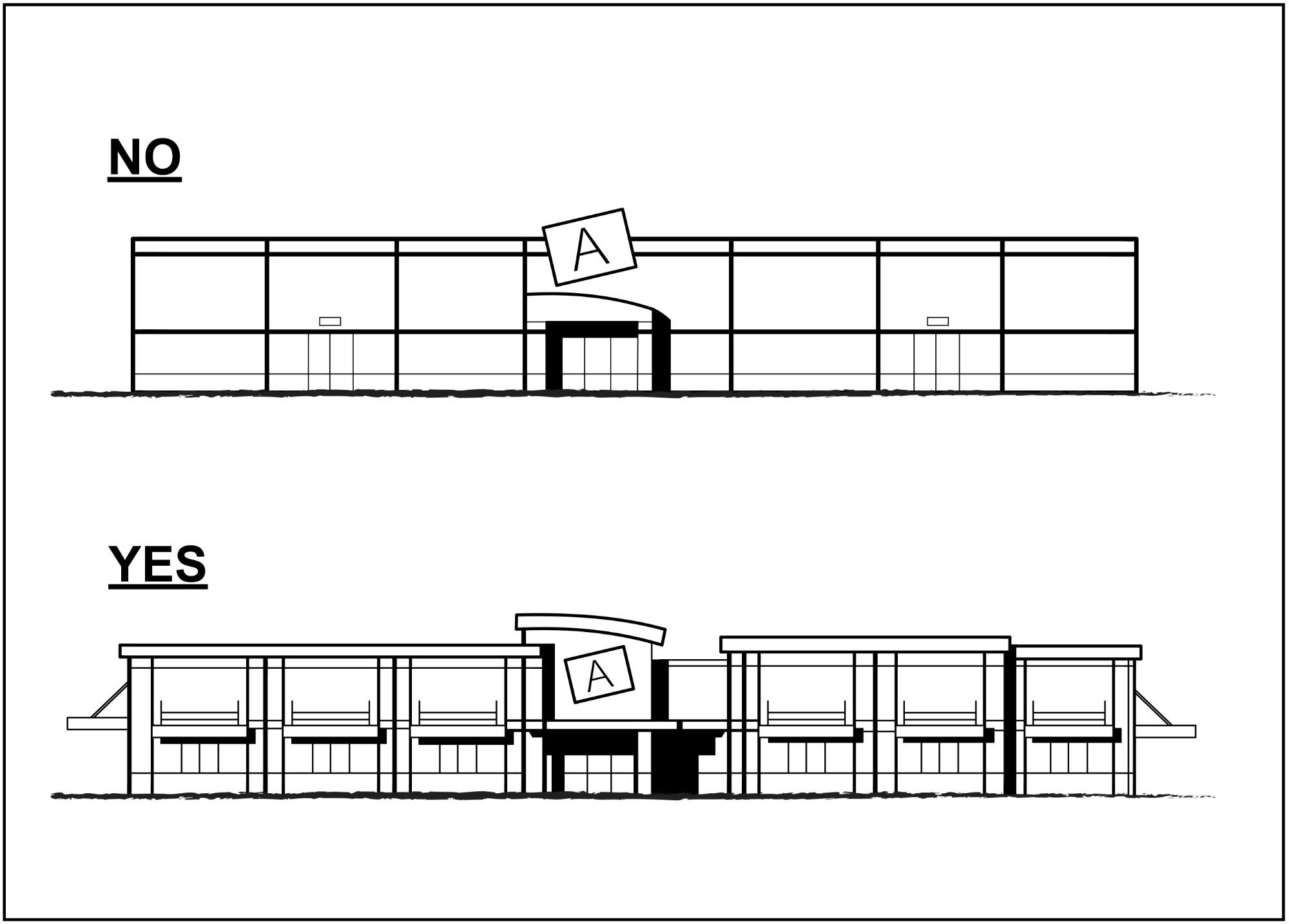
- Ground floor front Façade means the exterior, outward face of the building. that face Public Roadway means a road as defined in section 616 of the MGA and does not include a private roadway or highway., public sidewalks, or internal pedestrian walkways shall incorporate visual interest through articulation and other architectural features such as arcades, display windows, entry areas, Awning means a detachable, roof-like structure, covered by fabric or other flexible material, supported from a building by a fixed or retractable frame, without a supporting structure., recesses, or Architectural Projection means a building feature that is mounted on and/or extends from the surface of an exterior building wall or façade, typically above finished grade. Examples of architectural projections include balconies, bay windows, or cantilevered wall sections, not including eaves or chimneys.. They may also incorporate a high degree of visual interest through the use of colour change, texture change, or material module change;
- Roofs
- The roof line of buildings shall consist of varying pitches, or flat roofs that include articulation, and the use of design elements that reduce any perceived mass and linearity of large buildings, and add architectural interest; and
- Parapets concealing flat roofs and rooftop mechanical equipment from public view shall be provided. The average height of such parapets shall not exceed 15.00% of the height of the supporting wall, and such parapets shall not at any point exceed one-third of the height of the supporting wall;
- Entrances
- Entrances must coordinate with pedestrian networking and public connectivity to and through the site; and
- Each
Principal Building means a building that accommodates the principal use of a lot or site. on a site shall have clearly defined, highly visible public entrances, featuring no less than two of the following:
- Canopies or porticos;
- Overhangs;
- Recesses or projections;
- Arcades;
- Raised corniced parapets over the door;
- Peaked roof forms;
- Arches;
- Outdoor patios;
- Architectural details such as tile work and mouldings which are integrated into the building structure and design; or
- Integral planters or wing walls that incorporate landscaped areas or places for sitting.
- Development Regulations
- Central feature or
Amenity Area means any portion of a development site intended for active or passive recreation, including landscaped areas, patios, and balconies.
- The overall development shall contribute to the establishment or enhancement of public spaces by providing:
- At least one of the following:
- Patio means an at-grade concrete slab or other hard surface that adjoins a dwelling unit for the purpose of outdoor gatherings. or seating area;
- Pedestrian Plaza means an open space that provides opportunity for community gathering, events, and social interactions. with benches;
- Landscaped picnic area; or
- Transit stop with amenities (benches, shelter, etc.); and
- At least two of the following shall be provided:
- Tree, flower, or pollinator garden;
- Window-shopping walkway;
- Outdoor playground area;
- Kiosk area;
- Water feature;
- Art feature;
- Clock tower; or
- Other such deliberately shaped area, focal feature, or amenity, that, in the opinion of the Development Authority has the same meaning as set out in the MGA., adequately enhances public space.
- At least one of the following:
- The overall development shall contribute to the establishment or enhancement of public spaces by providing:
- Pedestrian flows
- Pedestrian walkways shall be designed to provide a safe and convenient route between focal points;
- Sidewalks shall be provided along all sides of the site that abut a Public Roadway means a road as defined in section 616 of the MGA and does not include a private roadway or highway., and all internal primary drive aisles. All sidewalks shall be continuous with other sidewalks or pedestrian walkways, both internally to the site and to adjacent developments;
- Continuous internal pedestrian walkways on the site shall be at least 5.91 ft. in width for the pedestrian thoroughfare, and provide a minimum additional 3.94 ft. of Landscaping means preserving, enhancing, or incorporating vegetative and other materials in a development, and includes combining new or existing vegetative materials with architectural elements, existing site features, or other development features – including fences or walls. on one or both sides of the walkway; and
- Sidewalks along buildings shall be:
- Provided along the full Façade means the exterior, outward face of the building. of the building, featuring a customer entrance, and along any façade abutting public Parking means leaving a vehicle temporarily on a lot or site. areas; and
- At least 11.81 ft. in width, of which 5.91 ft. will be a frontage zone for trees, benches, garbage cans, and other typical street amenities.
- Central feature or
Amenity Area means any portion of a development site intended for active or passive recreation, including landscaped areas, patios, and balconies.
- Parking and Loading Areas
-
Parking means leaving a vehicle temporarily on a lot or site. and loading areas must conform to the following requirements:
- A Loading Dock means a door used in connection with a loading space. shall be located in the side or rear of the site;
- The minimum
Setback means the distance from the foundation wall of a building to the property line at right angles or radially to it. Where there is no foundation wall, the distance shall be measured from the exterior wall at grade, not including cantilevered wall sections or architectural projections. for a
Parking Lot means a development which provides for the access, maneuvering, and parking of vehicles. or loading area is
9.84 ft. from any
Property Line means a line of record bounding a lot that divides one lot from another lot, a public roadway, or any other public space. that abuts a public right-of-way,
Residential District includes the LDR, SLR, LLR, FBR, MDR, HDR, MID (areas A and B), and ICC (Area A) Districts.,
Residential Use means congregate living (level one), congregate living (level two), dwelling (apartment), dwelling (duplex), dwelling (manufactured home), dwelling (secondary), dwelling (semi-detached), dwelling (single detached), dwelling (townhouse - complex), dwelling (townhouse - plex), dwelling (townhouse - single), dwelling unit above a non-residential use, group home, secondary suite (garage), secondary suite (garden), secondary suite (internal), supportive living accommodation, or townhousing.,
Natural Area means land or water, identified as environmentally sensitive, that requires protection and stewardship. Examples include wetlands, watercourses, ravines, forests, meadows, grasslands, and riparian areas., or
Park means land that is intended to be used by the public for active and passive recreation, or general enjoyment.;
- Notwithstanding section (ii), no parking lot or loading area shall be permitted within a required landscape buffer or perimeter landscape area;
- A parking lot or loading dock shall be Screening means the concealment of a development by a fence, wall, berm, landscaping, or combination thereof. Such screening is intended to mitigate any visual nuisance of the development. from the public right-of-way, Residential District, residential use, natural area, or park, to the satisfaction of the Development Authority has the same meaning as set out in the MGA.;
- Soft Landscaping means preserving, enhancing, or incorporating vegetative and other materials in a development, and includes combining new or existing vegetative materials with architectural elements, existing site features, or other development features – including fences or walls. is to be used to enhance and visually break up parking areas;
- A landscaping ratio of 19.91 sq. ft. per parking stall shall be provided;
- No parking stall shall be located more than 131.23 ft. from a landscaped area or island; and
- If the maximum number of parking stalls for a
Shopping Centre means a development comprised of three or more separate commercial or mixed-use buildings that operate as a unit and share a common parking area. or
Warehouse Store (Retail) means a development with a gross floor area of 4,000.00 m² (43,055.64 sq. ft.)or greater for the wholesale or retail sale of goods. Typical development includes a large grocery store, big box store, or home improvement store. is proposed to exceed one-and-a-half times the minimum required in Part 4: Parking of this Bylaw, the Development Authority may determine that at least one of the following requirements is met:
- Additional parking stalls exceeding one-and-a-half times the minimum required are to be provided either in a Parking Structure (Underground) means a building or portion thereof used for the parking of vehicles, where the majority of the parking structure is contained below finished grade., in a parking structure above the retail establishment, or Screening means the concealment of a development by a fence, wall, berm, landscaping, or combination thereof. Such screening is intended to mitigate any visual nuisance of the development. by peripheral buildings; or
- A combination of low-impact development techniques is implemented throughout the parking area.
-
Parking means leaving a vehicle temporarily on a lot or site. and loading areas must conform to the following requirements:
Last edited: February 3, 2026