Part 5 - Land Use Districts / Mixed-Use Districts
MID
This part outlines specific regulation that applies to the City’s Land Use Districts.
5.17 MID - Midtown District
- Application
- This section applies to the areas designated as Midtown (MID) District on the Land Use District Map, Schedule A of this Bylaw.
- The area designated as MID District encompasses residential areas A and B, and Mixed-Use Area C, as identified in Figure 5-8.
- Municipal reserves owing within the MID District will be districted Public Park (PRK) to align with the South Riel Area Structure Plan (ASP) means a statutory plan, as provided for in the MGA, which provides direction through policies on future development areas..
- The regulations of the MID District, as described within the South Riel ASP, shall apply to Lot A, Block 1, Plan 082 8697 only, including any future revisions to this legal description based on a subdivision or condominium plan.
- Development of the land uses within the MID District shall comply with the provisions of this Bylaw, except as otherwise stated within the MID District - in which case the MID District shall prevail.
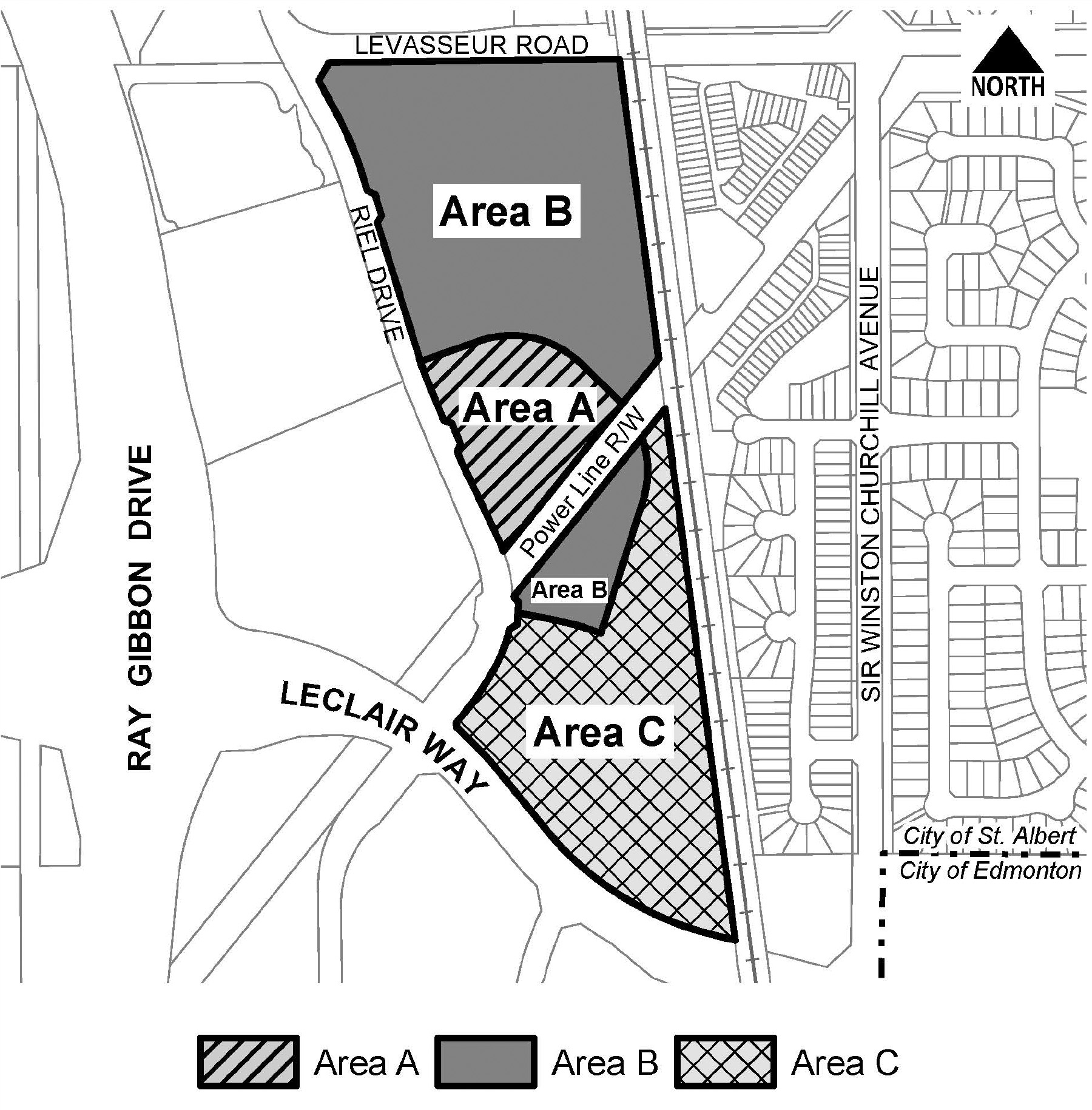
- Purpose
The purpose of the MID District is to develop a vibrant community that includes a mixture of commercial and medium- to high-density residential land uses in a comprehensively planned neighbourhood. The MID District shall be developed as bare land or a conventional condominium. The community will feature high-quality design, a broad mix of housing forms, employment opportunities, pedestrian accessibility, and a variety of public spaces. The neighbourhood will be developed into three character areas, residential areas A and B, located north of the AltaLink right-of-way, and Mixed-Use Area C - including residential and commercial uses, located south of the AltaLink right-of-way. The transition between these character areas is expected to be seamless, and connected through various pedestrian walkways and public and Private Roadway means a vehicle thoroughfare created for the purpose of vehicular access and circulation. It may include common property pursuant to the Condominium Property Act, RSA 2000, c. C-22, or be part of a lot, subject to a mutual access agreement. Private roadways include drive aisles.. The key attributes associated with the character areas include:- Residential areas A and B, which will provide a variety of housing types that are built in a compact form and have direct pedestrian accesses to community amenities;
- Mixed-Use Area C, which will provide high-density residential areas and commercial uses that are integrated through high-quality design. The residential uses can be in standalone forms or integrated vertically with commercial uses. The commercial uses will provide goods and services to local and surrounding neighbourhoods, as well as provide employment opportunities.
- Permitted and Discretionary Uses - Residential Areas A and B
| Permitted Uses | Discretionary Uses | |
|---|---|---|
| (i) | a) Community Garden means an area on a whole site or part of a site where flowers, vegetables, or fruit are cultivated for consumption or distribution on a not-for-profit basis. | b) Dwelling (Apartment) means a building containing three or more principal dwelling units with a common entrance from the exterior. (Area B only) |
| (i) | a) Dwelling (Duplex) means a single building on a single lot containing two dwelling units, each with a separate direct entrance from the exterior and one or more habitable rooms above finished grade. This use does not include dwelling (semi-detached). | b) Home-Based Business (Level Two) means an Accessory Development in a dwelling unit or an accessory building, for a business that is operated by a permanent resident of the dwelling unit, and may include one employee who does not reside on the property. This use does not include animal service, automotive (service), automotive specialty, fleet service, or a dry cleaner. |
| (ii) | a) Dwelling (Semi-Detached) means a single building containing two side-by-side dwelling units, each with its own title and direct connection to finished grade, and separated from each other by a party wall extending from foundation to roof, which is designed and constructed as two dwellings at the time of initial construction of the building. This use does not include dwelling (duplex). | b) Parking Lot means a development which provides for the access, maneuvering, and parking of vehicles. at Finished Grade means the elevation of the ground upon placement of soil and sod above the rough grade, or as may be identified on plot plans. |
| (iii) | a) Dwelling (Townhouse-Complex) means a development comprised of one or more buildings, each containing three or more dwelling units, all on a lot, where each unit has a separate, direct entrance from the exterior to grade. No dwelling (townhouse-complex) shall have less than five dwelling units total. This use may also include stacked townhousing, or a development of a mixed form, including townhousing incorporated with a dwelling (apartment) or dwelling unit above a non-residential use. | b) Public Utility Building means a development in which the owner or operator of a public utility maintains or houses any operation in connection with the distribution of a public utility, but does not include any development for the production of electric power or gas. |
| (iv) | a) Group Home means a development consisting of the use of a residential dwelling for care and supervision of occupants. A group home is intended to provide room and board for occupants requiring specialized or personal care, guidance, or supervision. The residential character of the development shall be primary, with the occupants living together as a single housekeeping group, and using cooking facilities shared in common. This does not include transitional accommodation. | b) Residential Sales Centre means a dwelling unit or temporary building used to exhibit dwelling units for sale, rent, or raffle. Typical uses include show or raffle homes. |
| (v) | a) Accessory means subordinate, incidental to, and exclusively devoted to a principal use or principal building. Development to a Permitted Use, excluding Deck means a raised platform, normally attached to a dwelling unit, which projects beyond the principal building, including balconies. that are greater than 4.92 ft. above Finished Grade means the elevation of the ground upon placement of soil and sod above the rough grade, or as may be identified on plot plans., Private Pool means any private swimming pool, whether above or below the ground. This does not include a decorative pond or hot tub., and Decorative Pond means any decorative pond, whether above or below the ground. This does not include a private pool. | b) Supportive Living Accommodation means a development, in a multiple-dwelling or sleeping-unit form, that provides residents with access to on-site professional care and daily living support, and is recognized, authorized, licensed, or certified by a public authority. |
| (vi) | b) Accessory means subordinate, incidental to, and exclusively devoted to a principal use or principal building. Development to a Discretionary Use, and decks that are greater than 4.92 ft. above finished grade, private pools, and decorative ponds |
| Permitted Uses | Discretionary Uses | |
|---|---|---|
| (i) | a) Amenity Area (Public) means any portion of a development intended for active or passive recreation, gathering, and enjoyment of the public, located and designed to maximize the accessibility and use of the area by the public during the hours that the surrounding development is open to the public. An amenity area (public) shall be owned and maintained by the owners of the development or in common. Access shall be at no cost to the public. | b) Animal Health means a development used for the medical care, treatment, and incidental overnight accommodation of a domestic pet, but not livestock. Typical development includes a veterinary clinic or animal hospital, not including animal service. |
| (ii) | a) Animal Grooming means a development entirely located within an enclosed building for the grooming of a domestic pet. This does not include animal service. | b) Broadcasting Studio means a development used for the production or broadcast of audio or visual programming, including radio, music, television, and movie programs. |
| (iii) | a) Art Gallery/Studio means a public or private facility which is used for the production or sale of or as a repository of works of individual art pieces not mass produced, including paintings, photographs, drawings, etchings, pottery, or sculptures. | b) Community Garden means an area on a whole site or part of a site where flowers, vegetables, or fruit are cultivated for consumption or distribution on a not-for-profit basis. |
| (iv) | a) Dwelling (Apartment) means a building containing three or more principal dwelling units with a common entrance from the exterior. | b) Conference and Banquet Facility means a development that provides auditorium, banquet, exhibition, gymnasium, meeting, or seminar facilities. This use does not include establishment (gaming). |
| (v) | a) Dwelling Unit Above a Non-Residential Use means a dwelling unit, located in a mixed-use building, which is located above any non-residential use. | b) Daycare Facility means a development used to provide care and supervision to seven or more children or adults. Typical development includes daycare centres, preschools, kindergartens, and adult support programs. |
| (vi) | a) Establishment (Brew Pub) means a development where food and beverages are prepared and served for consumption by the public, and alcoholic beverages, excluding spirits, are brewed on the premises as an accessory use. This use may include accessory retail sales on or off the premises. This use does not include establishment (drinking) or establishment (restaurant). | b) Equipment Service means a development that provides repair services for household goods, equipment, and appliances. Typical uses include radio, television, and appliance repair shops, and furniture refinishing and upholstery shops. |
| (vii) | a) Establishment (Restaurant) means a development where food and beverages are prepared and served for consumption by the public. Typical development includes restaurants, fast-food restaurants, and takeout restaurants, not including establishment (brew pub) or establishment (drinking). | b) Establishment (Drinking) means a development licensed to serve alcoholic beverages for consumption on the premises, and may include up to 10 video lottery terminals as an accessory use. This use does not include establishment (brew pub) or establishment (restaurant). |
| (viii) | a) Government Service means a development where municipal, provincial, or federal government services are provided directly to the public, and includes development required for the public protection of persons or property. Typical development includes a police station, fire station, courthouse, post office, transit service, public museum, library, school board or social services office. | b) Establishment (Entertainment) means a development where live performances or motion pictures are shown. Typical development includes a cinema, theatre, or music hall, not including establishment (adult). |
| (ix) | a) Group Home means a development consisting of the use of a residential dwelling for care and supervision of occupants. A group home is intended to provide room and board for occupants requiring specialized or personal care, guidance, or supervision. The residential character of the development shall be primary, with the occupants living together as a single housekeeping group, and using cooking facilities shared in common. This does not include transitional accommodation. | b) Home-Based Business (Level Two) means an Accessory Development in a dwelling unit or an accessory building, for a business that is operated by a permanent resident of the dwelling unit, and may include one employee who does not reside on the property. This use does not include animal service, automotive (service), automotive specialty, fleet service, or a dry cleaner. |
| (x) | a) Health Service means a development used for the provision of physical and mental out-patient health care, and social or counselling services. Services may be of a preventative, diagnostic, treatment, therapeutic, rehabilitative, or counselling nature. Typical development includes medical and dental offices, health and physiotherapy clinics, or massage therapy clinics. | b) Hotel means a commercial development used to provide temporary sleeping accommodation to the public, and which may also contain a restaurant, drinking establishment, or conference and banquet facility. Typical development includes a hotel, hostel, or motel. |
| (xi) | a) Live/Work Unit means a unit designed to be used concurrently as a dwelling unit and as a commercial use. | b) Religious Assembly means a development used for worship and related religious, philanthropic, or social activities, and includes accessory rectories, manses, meeting rooms, and food preparation and service facilities. Typical uses include churches, chapels, mosques, temples, synagogues, parish halls, convents, or monasteries. |
| (xii) | a) Parking Lot means a development which provides for the access, maneuvering, and parking of vehicles. at Finished Grade means the elevation of the ground upon placement of soil and sod above the rough grade, or as may be identified on plot plans. | b) Residential Sales Centre means a dwelling unit or temporary building used to exhibit dwelling units for sale, rent, or raffle. Typical uses include show or raffle homes. |
| (xiii) | a) Parking Structure means a building or portion thereof used for the parking of vehicles, and may be located either below, at, or above finished grade. | b) Retail (Cannabis) means a development used for the retail sale of cannabis that is authorized by provincial or federal legislation. This does not include a cannabis production and distribution facility or a cannabis production and distribution facility (micro). |
| (xiv) | a) Personal Service means a development used to provide services related to the care and appearance of an individual, including the cleaning and repair of clothing, but does not include health service or establishment (adult). Typical development includes dry cleaner, hair salon, tanning salon, laundromat, tailor, shoe repair, and aesthetician services. | b) School (Commercial) means a commercial development used for training and instruction in a trade, skill, or service. Typical development includes trade, secretarial, business, hairdressing, driver training, music, or academic tutoring schools, not including school (elementary or secondary) or school (post-secondary). |
| (xv) | a) Professional Office means an office use providing professional services. Typical development includes offices providing accounting, architectural, employment, engineering, insurance, investment, legal, real estate, planning, secretarial, broadcasting studios, and travel agent services. This use does not include health service or government service. | b) Accessory means subordinate, incidental to, and exclusively devoted to a principal use or principal building. Development to a Permitted Use or Discretionary Use |
| (xvi) | a) Public Utility Building means a development in which the owner or operator of a public utility maintains or houses any operation in connection with the distribution of a public utility, but does not include any development for the production of electric power or gas. | |
| (xvii) | a) Recreation (Indoor) means a development used for sports or recreation within an enclosed building. Typical development includes a health and fitness club, swimming pool, bowling alley, amusement arcade, athletic field, rink, or court, not including conference and banquet facility or establishment (gaming). | |
| (xviii) | a) Retail (General) means a development for the retail sale of a wide range of consumer goods and services with a floor area less than 4,000.00 m² (43,055.64 sq. ft.), but does not include a warehouse store (retail). Typical development includes a grocery store, variety store, clothing store, sporting goods store, furniture store, jewelry store, financial institution, pharmacy, or liquor store. | |
| (xix) | a) Shopping Centre means a development comprised of three or more separate commercial or mixed-use buildings that operate as a unit and share a common parking area. | |
| (xx) | a) Supportive Living Accommodation means a development, in a multiple-dwelling or sleeping-unit form, that provides residents with access to on-site professional care and daily living support, and is recognized, authorized, licensed, or certified by a public authority. |
- No non-residential use is allowed above a residential use.
- Application Requirements
- In addition to the plans and information required under section 2.4, an Applicant for a
Development Permit means the document issued by the Development Authority or by Council in a Direct Control District under this Bylaw or any previous Land Use Bylaw, and includes any plans or conditions of approval. must submit, to the satisfaction of the
Development Authority has the same meaning as set out in the MGA.:
- An overall
Conceptual Site Development Plan means a development plan for a site or lot, which identifies how a proposed development will fit into the larger development area, including the proposed building types and location, development phasing, vehicular and pedestrian routes, connectivity, parks, amenity areas, and on-site signage. for:
- The area designated as MID District; or
- If the Applicant is only developing a portion of the area designated as MID District, a site development plan showing the area to be developed and illustrating how the development will be integrated with the entire area designated as MID District;
- The overall conceptual site development plan, considered to be non-binding, must identify the proposed building types and locations, development phasing, Density means the number of dwelling units and live/work units on a lot, expressed in units per hectare or in units per lot, not including secondary suites. calculations, vehicular and pedestrian routes, and Amenity Area means any portion of a development site intended for active or passive recreation, including landscaped areas, patios, and balconies., in accordance with the purpose of this District;
- Details regarding the architectural guidelines proposed for the development, including design drawings illustrating the colour scheme and building materials;
- Any other studies that may be requested by the Development Authority, including one or more of the following:
- A traffic impact analysis that demonstrates that traffic impacts are compatible with the purpose of the MID District, and do not prejudice safety and traffic movements within the MID District or on adjacent Public Roadway means a road as defined in section 616 of the MGA and does not include a private roadway or highway.;
- Crime Prevention Through Environmental Design ( CPTED (Crime Prevention Through Environmental Design) means the broad study and design of environments to encourage desirable behaviour and functionality, and decrease undesirable behaviour and criminal actions.) study to be submitted at the time of a Development Permit application; or
- A geotechnical report.
- An overall
Conceptual Site Development Plan means a development plan for a site or lot, which identifies how a proposed development will fit into the larger development area, including the proposed building types and location, development phasing, vehicular and pedestrian routes, connectivity, parks, amenity areas, and on-site signage. for:
- Changes to an approved overall conceptual site development plan may require resubmission for review by the Development Authority.
- In addition to the plans and information required under section 2.4, an Applicant for a
Development Permit means the document issued by the Development Authority or by Council in a Direct Control District under this Bylaw or any previous Land Use Bylaw, and includes any plans or conditions of approval. must submit, to the satisfaction of the
Development Authority has the same meaning as set out in the MGA.:
- Urban Design Review (External) - Area C
- In addition to the requirements of section 3.41 ‘Urban Design Review’ an
Urban Design Review (External) means a preliminary review of the design and architecture of a proposed development conducted by a contracted third party or an appointed review committee. is required for any development that:
- Has a total building footprint greater than 26,909.78 sq. ft.;
- Is greater than 91.86 ft. in height; or
- In the opinion of the Development Authority, is deemed to have a significant impact on the urban design of Area C.
- In addition to the requirements of section 3.41 ‘Urban Design Review’ an
Urban Design Review (External) means a preliminary review of the design and architecture of a proposed development conducted by a contracted third party or an appointed review committee. is required for any development that:
- Urban Design Review (Internal) - Area C
- Notwithstanding section (6)(a), if a development does not require an Urban Design Review (External) means a preliminary review of the design and architecture of a proposed development conducted by a contracted third party or an appointed review committee., but an Applicant wishes to receive recommendations related to urban design, they may request an Urban Design Review (Internal) means a preliminary review of the design and architecture of a proposed development, conducted by internal staff designated by the Development Authority. be completed by staff designated by the Development Authority, prior to submission of an application.
- Performance Standards
- In addition to the Urban Design Review Recommendations Report, all applications shall be considered with regard to the following Performance Standards:
- Site design contribution to Streetscape means the area that lies between the street curb and the building frontage of the adjacent buildings, the role of which is to define the pedestrian corridor and the distinguishing character of a particular street, including landscaping, trees, lawns, sidewalks and other surfacing, lighting, street furniture, and signage. and the character of the area;
- Appropriate location of uses to support active streetscape;
- High-quality building design integrated with streetscape and surrounding buildings;
- Pedestrian orientation; and
- Well-designed Amenity Area means any portion of a development site intended for active or passive recreation, including landscaped areas, patios, and balconies..
- In addition to the Urban Design Review Recommendations Report, all applications shall be considered with regard to the following Performance Standards:
- Site Density
- The
Site Density means the number of dwelling units per hectare of site area. for the MID District is as follows:
- The minimum site density shall be 40 Dwelling or Dwelling Unit means a self-contained residence comprising cooking, washroom, living, and sleeping facilities with a separate private entrance from the exterior of a building or from a common hall, lobby, or stairway inside a building, but does not include any part of a hospital, hotel, or recreation vehicle. per net hectare to a maximum of 54 dwelling units per net hectare for residential Area A;
- The minimum site density shall be 40 dwelling units per net hectare to a maximum of 94 dwelling units per net hectare for residential Area B;
- The minimum site density shall be 120 dwelling units per net hectare to a maximum of 250 dwelling units per net hectare for Mixed-Use Area C; and
- Notwithstanding sections (i) through (iii), the overall density for the MID District shall be 81 dwelling units per net hectare.
- The
Site Density means the number of dwelling units per hectare of site area. for the MID District is as follows:
- Site Density Bonus
- Notwithstanding section (9)(a)(iii), the maximum
Site Density means the number of dwelling units per hectare of site area. may exceed 250 dwelling units per net hectare in Area C, only if the following conditions are met:
- A minimum of 70% of required Parking means leaving a vehicle temporarily on a lot or site. stalls are provided in a Parking Structure (Underground) means a building or portion thereof used for the parking of vehicles, where the majority of the parking structure is contained below finished grade. or within a Parking Structure means a building or portion thereof used for the parking of vehicles, and may be located either below, at, or above finished grade. integrated within the building, including high-quality exterior finishing that matches or complements the Principal Building means a building that accommodates the principal use of a lot or site. exterior, where site design permits;
- A minimum of 5% of Dwelling or Dwelling Unit means a self-contained residence comprising cooking, washroom, living, and sleeping facilities with a separate private entrance from the exterior of a building or from a common hall, lobby, or stairway inside a building, but does not include any part of a hospital, hotel, or recreation vehicle. shall be provided as Affordable Non-Market Housing is as defined in the Council Policy C-P&E-06 Affordable Housing.; and
- In the opinion of the Development Authority, at least one of the following site improvements are provided:
- Wider sidewalks or walkways internal to the site, together with street furniture to the satisfaction of the Development Authority;
- Enhanced Landscaping means preserving, enhancing, or incorporating vegetative and other materials in a development, and includes combining new or existing vegetative materials with architectural elements, existing site features, or other development features – including fences or walls., to the satisfaction of the Development Authority;
- Landscaping that is drought-tolerant, reducing the need for irrigation;
- Green building products or technologies that reduce the carbon footprint or increase energy efficiency;
- Barrier-Free means to allow proper and safe access and use of buildings, facilities, and open areas, with a proper and safe outcome for accessibility. design incorporated into dwelling units and the exterior feature of the site; or
- Indoor or outdoor common
Amenity Area means any portion of a development site intended for active or passive recreation, including landscaped areas, patios, and balconies., in addition to the minimum required common and private amenity areas, when:
- Provided at a ratio of 16.15 sq. ft. per dwelling unit;
- Grouped into areas of not less than 322.91 sq. ft. ; and
- Notwithstanding section (9)(a)(iii), the maximum
Site Density means the number of dwelling units per hectare of site area. may exceed 250 dwelling units per net hectare in Area C, only if the following conditions are met:
- Amenity Area (Private)
- Each
Dwelling or Dwelling Unit means a self-contained residence comprising cooking, washroom, living, and sleeping facilities with a separate private entrance from the exterior of a building or from a common hall, lobby, or stairway inside a building, but does not include any part of a hospital, hotel, or recreation vehicle. must be provided with at least one of the following forms of an
Amenity Area (Private) means a balcony, patio, deck, or other similar structure which is attached to and has a private entrance from the interior of a dwelling unit.:
- A Deck means a raised platform, normally attached to a dwelling unit, which projects beyond the principal building, including balconies. or Balcony means an above-grade exterior platform projecting from a wall and located adjacent to an entry to a dwelling unit.;
- A Patio means an at-grade concrete slab or other hard surface that adjoins a dwelling unit for the purpose of outdoor gatherings. or yard; or
- A recessed balcony or sunroom enclosed with exterior windows.
- An amenity area (private) must be located next to a Habitable Room means a bedroom, dining room, family room, or living room..
- An amenity area (private) must have a minimum area of 43.06 sq. ft..
- An amenity area (private), at ground level and adjacent to public areas, must have a Landscape Buffer means a landscaped area with dense landscaping, intended to separate and screen adjacent differing land uses. at least 3.28 ft. wide or a Fence means a vertical physical barrier constructed to provide visual screening or to enclose a lot or site. with a minimum height of 3.94 ft..
- Notwithstanding the requirements of sections (a) through (d):
- Up to 25% of the required Amenity Area (Private) means a balcony, patio, deck, or other similar structure which is attached to and has a private entrance from the interior of a dwelling unit. may be substituted for an On-Site means a location on the site which is the subject of a development. Amenity Area (Common) means any portion of a development intended for active or passive recreation that is designed for the common usage of the owners and residents within a development. These areas may include one or more of the following: plazas, courtyards, recreation areas, swimming pools, tennis courts, bike storage rooms, common gathering rooms, gardens, private parks, and open spaces, including elements such as street furnishings, hard-surfacing, plantings, and architectural features that create a strong sense of communal gathering space. that is accessible to all residents, at the discretion of the Development Authority, for all dwelling units except Supportive Living Accommodation means a development, in a multiple-dwelling or sleeping-unit form, that provides residents with access to on-site professional care and daily living support, and is recognized, authorized, licensed, or certified by a public authority.; and
- Up to 100% of the required amenity area (private) may be substituted for an on-site amenity area (common) that is accessible to all residents, at the discretion of the Development Authority, for supportive living accommodation.
-
Balcony means an above-grade exterior platform projecting from a wall and located adjacent to an entry to a dwelling unit. and
Deck means a raised platform, normally attached to a dwelling unit, which projects beyond the principal building, including balconies. must be located at least
3.28 ft. from:
- All Property Line means a line of record bounding a lot that divides one lot from another lot, a public roadway, or any other public space.;
- A roadway;
- A common or visitor parking stall; and
- A common walkway, except that portion of the walkway that provides direct access to the building.
- Notwithstanding the provisions under section (f), a deck may be developed to a 0.00 m Setback means the distance from the foundation wall of a building to the property line at right angles or radially to it. Where there is no foundation wall, the distance shall be measured from the exterior wall at grade, not including cantilevered wall sections or architectural projections. along the centre line of the common firewalls on a Dwelling (Duplex) means a single building on a single lot containing two dwelling units, each with a separate direct entrance from the exterior and one or more habitable rooms above finished grade. This use does not include dwelling (semi-detached)., Dwelling (Semi-Detached) means a single building containing two side-by-side dwelling units, each with its own title and direct connection to finished grade, and separated from each other by a party wall extending from foundation to roof, which is designed and constructed as two dwellings at the time of initial construction of the building. This use does not include dwelling (duplex)., and Dwelling (Townhouse) means a building comprised of three or more dwelling units, where each unit has a separate, direct entrance from the exterior to grade, and includes dwelling (townhouse-single), dwelling (townhouse-plex), and dwelling (townhouse-complex). Typical examples include back-to-back townhouses, stacked townhouses, and street-oriented townhouses..
- Each
Dwelling or Dwelling Unit means a self-contained residence comprising cooking, washroom, living, and sleeping facilities with a separate private entrance from the exterior of a building or from a common hall, lobby, or stairway inside a building, but does not include any part of a hospital, hotel, or recreation vehicle. must be provided with at least one of the following forms of an
Amenity Area (Private) means a balcony, patio, deck, or other similar structure which is attached to and has a private entrance from the interior of a dwelling unit.:
- Amenity Area (Common)
- The MID District shall provide an outdoor
Amenity Area (Common) means any portion of a development intended for active or passive recreation that is designed for the common usage of the owners and residents within a development. These areas may include one or more of the following: plazas, courtyards, recreation areas, swimming pools, tennis courts, bike storage rooms, common gathering rooms, gardens, private parks, and open spaces, including elements such as street furnishings, hard-surfacing, plantings, and architectural features that create a strong sense of communal gathering space. as follows:
- Areas A, B, and C shall each provide at least two amenity area (common) spaces;
- Amenity area (common) may include:
- A rooftop amenity area or rooftop garden, not less than 322.91 sq. ft.;
- A Balcony means an above-grade exterior platform projecting from a wall and located adjacent to an entry to a dwelling unit. or terraced balcony, not less than 322.91 sq. ft.;
- An at- Grade means either rough grade or finished grade, depending on the application context. amenity area, including a common garden area, not less than 322.91 sq. ft.; or
- Some other amenity area (common), including an interior amenity area not less than 322.91 sq. ft., which is common to and accessible by all residents, excluding Parking means leaving a vehicle temporarily on a lot or site. lots and pedestrian walkways;
- Each amenity area (common) shall have a minimum area of 5,381.96 sq. ft., excluding parking lots and pedestrian walkways;
- Each amenity area (common) shall have a minimum width of 19.65 ft. at its narrowest point;
- The amenity area (common) shall not be located in any required Setback means the distance from the foundation wall of a building to the property line at right angles or radially to it. Where there is no foundation wall, the distance shall be measured from the exterior wall at grade, not including cantilevered wall sections or architectural projections.;
- The amenity area (common) required under section (11) is in addition to an amenity area (common) that may be provided under section (10)(e); and
- The Development Authority has the same meaning as set out in the MGA. may, at its discretion, vary the requirements of sections (ii) and (iii) above, taking into account site constraints, adjacent uses, and urban design considerations.
- The MID District shall provide an outdoor
Amenity Area (Common) means any portion of a development intended for active or passive recreation that is designed for the common usage of the owners and residents within a development. These areas may include one or more of the following: plazas, courtyards, recreation areas, swimming pools, tennis courts, bike storage rooms, common gathering rooms, gardens, private parks, and open spaces, including elements such as street furnishings, hard-surfacing, plantings, and architectural features that create a strong sense of communal gathering space. as follows:
- Walkways
- All common walkways shall have a minimum width of 4.92 ft., except that portion of the walkway that provides direct access to the building.
- Lot Width
- For residential bare land condominium development:
- When vehicular access is provided from the front:
- The minimum
Lot Width means the distance between the side property lines, as measured along the minimum front yard building setback, unless otherwise specified in this Bylaw. for a
Dwelling (Duplex) means a single building on a single lot containing two dwelling units, each with a separate direct entrance from the exterior and one or more habitable rooms above finished grade. This use does not include dwelling (semi-detached). is:
- 36.09 ft. on an Interior Lot means any lot other than a corner lot.;
- 51.84 ft. on a Corner Lot means a lot located at the intersection of two or more public roadways, but not the intersection of a street and a rear lane, or a lot that has two public road frontages.; and
- The minimum lot width for a
Dwelling (Semi-Detached) means a single building containing two side-by-side dwelling units, each with its own title and direct connection to finished grade, and separated from each other by a party wall extending from foundation to roof, which is designed and constructed as two dwellings at the time of initial construction of the building. This use does not include dwelling (duplex). is:
- 18.04 ft. per dwelling unit on an interior lot;
- 33.79 ft. per dwelling unit on a corner lot; and
- The minimum lot width for
Dwelling (Townhouse-Complex) means a development comprised of one or more buildings, each containing three or more dwelling units, all on a lot, where each unit has a separate, direct entrance from the exterior to grade. No dwelling (townhouse-complex) shall have less than five dwelling units total. This use may also include stacked townhousing, or a development of a mixed form, including townhousing incorporated with a dwelling (apartment) or dwelling unit above a non-residential use.
is:
- 14.11 ft. per Townhouse (Interior Unit) means a dwelling unit forming part of a townhouse building, which is not a townhouse (end unit).;
- 18.04 ft. per Townhouse (End Unit) means the last dwelling unit forming the end of a townhouse building. on an interior lot;
- 33.79 ft. per townhouse (end unit) on a corner lot; and
- The minimum
Lot Width means the distance between the side property lines, as measured along the minimum front yard building setback, unless otherwise specified in this Bylaw. for a
Dwelling (Duplex) means a single building on a single lot containing two dwelling units, each with a separate direct entrance from the exterior and one or more habitable rooms above finished grade. This use does not include dwelling (semi-detached). is:
- When vehicular access is provided from the rear:
- The minimum
Lot Width means the distance between the side property lines, as measured along the minimum front yard building setback, unless otherwise specified in this Bylaw. for a
Dwelling (Duplex) means a single building on a single lot containing two dwelling units, each with a separate direct entrance from the exterior and one or more habitable rooms above finished grade. This use does not include dwelling (semi-detached). is:
- 48.23 ft. on an Interior Lot means any lot other than a corner lot.; and
- 63.98 ft. on a Corner Lot means a lot located at the intersection of two or more public roadways, but not the intersection of a street and a rear lane, or a lot that has two public road frontages.;
- The minimum lot width for a
Dwelling (Semi-Detached) means a single building containing two side-by-side dwelling units, each with its own title and direct connection to finished grade, and separated from each other by a party wall extending from foundation to roof, which is designed and constructed as two dwellings at the time of initial construction of the building. This use does not include dwelling (duplex). is:
- 24.28 ft. per dwelling unit on an interior lot;
- 40.03 ft. per dwelling unit on a corner lot; and
- The minimum lot width for a
Dwelling (Townhouse-Complex) means a development comprised of one or more buildings, each containing three or more dwelling units, all on a lot, where each unit has a separate, direct entrance from the exterior to grade. No dwelling (townhouse-complex) shall have less than five dwelling units total. This use may also include stacked townhousing, or a development of a mixed form, including townhousing incorporated with a dwelling (apartment) or dwelling unit above a non-residential use.
is:
- 20.34 ft. per Townhouse (Interior Unit) means a dwelling unit forming part of a townhouse building, which is not a townhouse (end unit).;
- 24.28 ft. per Townhouse (End Unit) means the last dwelling unit forming the end of a townhouse building. on an interior lot; and
- 40.03 ft.per townhouse (end unit) on a corner lot.
- The minimum
Lot Width means the distance between the side property lines, as measured along the minimum front yard building setback, unless otherwise specified in this Bylaw. for a
Dwelling (Duplex) means a single building on a single lot containing two dwelling units, each with a separate direct entrance from the exterior and one or more habitable rooms above finished grade. This use does not include dwelling (semi-detached). is:
- When vehicular access is provided from the front:
- For residential bare land condominium development:
- Lot Depth
- For residential bare land condominium development, the minimum
Lot Depth means the distance between the front and rear property lines of the lot, as measured perpendicularly or radially from the mid-point of the front property line to the mid-point of the rear property line of the lot. is:
-
52.49 ft. when vehicular access is provided from the front for a:
- Dwelling (Duplex) means a single building on a single lot containing two dwelling units, each with a separate direct entrance from the exterior and one or more habitable rooms above finished grade. This use does not include dwelling (semi-detached).;
- Dwelling (Semi-Detached) means a single building containing two side-by-side dwelling units, each with its own title and direct connection to finished grade, and separated from each other by a party wall extending from foundation to roof, which is designed and constructed as two dwellings at the time of initial construction of the building. This use does not include dwelling (duplex).; and
- Dwelling (Townhouse-Complex) means a development comprised of one or more buildings, each containing three or more dwelling units, all on a lot, where each unit has a separate, direct entrance from the exterior to grade. No dwelling (townhouse-complex) shall have less than five dwelling units total. This use may also include stacked townhousing, or a development of a mixed form, including townhousing incorporated with a dwelling (apartment) or dwelling unit above a non-residential use. ; and
-
52.49 ft. when vehicular access is provided from the front for a:
-
39.37 ft. when vehicular access is provided from a rear
Lane means an alley as defined in the Traffic Safety Act, RSA 2000, c.T-6. for a:
- Dwelling (duplex);
- Dwelling (semi-detached); and
- Dwelling (townhouse-complex).
- For residential bare land condominium development, the minimum
Lot Depth means the distance between the front and rear property lines of the lot, as measured perpendicularly or radially from the mid-point of the front property line to the mid-point of the rear property line of the lot. is:
- Lot Coverage
- The maximum
Lot Coverage means the percentage of the lot area covered by buildings. for bare land condominium development is:
- 58% for a dwelling (duplex); dwelling (semi-detached); and Townhouse (End Unit) means the last dwelling unit forming the end of a townhouse building.; and
- 70% for a Townhouse (Interior Unit) means a dwelling unit forming part of a townhouse building, which is not a townhouse (end unit)..
- The maximum
Lot Coverage means the percentage of the lot area covered by buildings. for bare land condominium development is:
- Lot Frontage
- The minimum
Lot Frontage means the width of a lot or site at the front property line adjoining a public roadway. is
82.02 ft. for:
- Conventional condominium development;
- Dwelling (Apartment) means a building containing three or more principal dwelling units with a common entrance from the exterior.; and
- Dwelling Unit Above a Non-Residential Use means a dwelling unit, located in a mixed-use building, which is located above any non-residential use..
- The minimum
Lot Frontage means the width of a lot or site at the front property line adjoining a public roadway. is
82.02 ft. for:
- Lot Area
- The minimum
Lot Area means the area of a lot, including any area dedicated to an easement or a right-of-way, as shown on a plan of subdivision or described in a copy of a certificate of title. is
0.19 acres for:
- Conventional condominium development;
- Dwelling (apartment); and
- Mixed-Use Building means the development of a building with a variety of complementary and integrated uses, which includes a residential component and a non-residential component, in a compact, urban form. The non-residential component may include office, retail, government service, restaurant, or entertainment in a compact urban form..
- The minimum
Lot Area means the area of a lot, including any area dedicated to an easement or a right-of-way, as shown on a plan of subdivision or described in a copy of a certificate of title. is
0.19 acres for:
- Building Height
- The maximum height of a principal building:
- Dwelling (Duplex) means a single building on a single lot containing two dwelling units, each with a separate direct entrance from the exterior and one or more habitable rooms above finished grade. This use does not include dwelling (semi-detached). and Dwelling (Semi-Detached) means a single building containing two side-by-side dwelling units, each with its own title and direct connection to finished grade, and separated from each other by a party wall extending from foundation to roof, which is designed and constructed as two dwellings at the time of initial construction of the building. This use does not include dwelling (duplex)., is 49.21 ft.;
- Dwelling (Townhouse-Complex) means a development comprised of one or more buildings, each containing three or more dwelling units, all on a lot, where each unit has a separate, direct entrance from the exterior to grade. No dwelling (townhouse-complex) shall have less than five dwelling units total. This use may also include stacked townhousing, or a development of a mixed form, including townhousing incorporated with a dwelling (apartment) or dwelling unit above a non-residential use. , is 59.06 ft.;
- Dwelling (Apartment) means a building containing three or more principal dwelling units with a common entrance from the exterior. (Area B only), is 59.06 ft.; and
- Dwelling (apartment), mixed-use building (Area C only), or non-residential building, is 82.02 ft..
- Notwithstanding section (a), at the discretion of the
Development Authority has the same meaning as set out in the MGA., the maximum building height may be increased up to
114.83 ft. if a development provides at least two of the following:
- Superior or innovative building style;
- High-quality exterior finishing including, brick, brick veneer, wood, natural stone, tinted or textural concrete, glass, or concrete masonry units;
- A distinct building base or podium with a 9.84 ft. minimum Step-Back means a horizontal recess to a building façade from the vertical façade immediately below it. provided for upper floors, measured from the building face of the podium, with consideration for the transitions between adjacent building designs and heights;
- Green building products or technologies that reduce the carbon footprint or increase energy efficiency;
- Peaked roof; or
- Enhanced Landscaping means preserving, enhancing, or incorporating vegetative and other materials in a development, and includes combining new or existing vegetative materials with architectural elements, existing site features, or other development features – including fences or walls..
- The maximum height of a principal building:
- Residential Bare Land Condominium Setbacks
- For a residential bare land condominium development of
Dwelling (Duplex) means a single building on a single lot containing two dwelling units, each with a separate direct entrance from the exterior and one or more habitable rooms above finished grade. This use does not include dwelling (semi-detached).;
Dwelling (Semi-Detached) means a single building containing two side-by-side dwelling units, each with its own title and direct connection to finished grade, and separated from each other by a party wall extending from foundation to roof, which is designed and constructed as two dwellings at the time of initial construction of the building. This use does not include dwelling (duplex).; and
Dwelling (Townhouse-Complex) means a development comprised of one or more buildings, each containing three or more dwelling units, all on a lot, where each unit has a separate, direct entrance from the exterior to grade. No dwelling (townhouse-complex) shall have less than five dwelling units total. This use may also include stacked townhousing, or a development of a mixed form, including townhousing incorporated with a dwelling (apartment) or dwelling unit above a non-residential use.
:
- The minimum front yard building
Setback means the distance from the foundation wall of a building to the property line at right angles or radially to it. Where there is no foundation wall, the distance shall be measured from the exterior wall at grade, not including cantilevered wall sections or architectural projections. is:
- 9.84 ft. when vehicular access is provided from the rear;
- 19.65 ft. when vehicular access is provided from the front;
- 19.65 ft. when development is fronting LeClair Way, Levasseur Road, and Riel Drive; and
- The projection shall not span the entire width of the dwelling;
- Notwithstanding section (i), for development fronting LeClair Way, Levasseur Road, and Riel Drive, a covered stairway which only serves to provide direct access to the dwelling may project up to 8.20 ft. into the minimum required 19.65 ft. front yard setback;
- The minimum side yard building setback is:
- 0.00 m to the centre line of the interior common firewalls;
- 3.94 ft. to the outside of the exterior wall on an Interior Lot means any lot other than a corner lot.; and
- 7.87 ft. to the outside of the exterior wall on a Corner Lot means a lot located at the intersection of two or more public roadways, but not the intersection of a street and a rear lane, or a lot that has two public road frontages.;
- The minimum rear yard building
Setback means the distance from the foundation wall of a building to the property line at right angles or radially to it. Where there is no foundation wall, the distance shall be measured from the exterior wall at grade, not including cantilevered wall sections or architectural projections. is:
- 4.92 ft. when vehicular access is provided from a rear Lane means an alley as defined in the Traffic Safety Act, RSA 2000, c.T-6.;
- 9.84 ft. when vehicular access is provided from the front; and
- 0.00 m for a back-to-back Dwelling (Townhouse-Complex) means a development comprised of one or more buildings, each containing three or more dwelling units, all on a lot, where each unit has a separate, direct entrance from the exterior to grade. No dwelling (townhouse-complex) shall have less than five dwelling units total. This use may also include stacked townhousing, or a development of a mixed form, including townhousing incorporated with a dwelling (apartment) or dwelling unit above a non-residential use. ; and
- Notwithstanding section (iii), a development without an attached Garage means a building that is intended to provide parking for vehicles, is enclosed on all sides, and may either be attached to or detached from the principal building. and no lane must have a minimum side yard building setback of
- The minimum front yard building
Setback means the distance from the foundation wall of a building to the property line at right angles or radially to it. Where there is no foundation wall, the distance shall be measured from the exterior wall at grade, not including cantilevered wall sections or architectural projections. is:
- For a residential bare land condominium development of
Dwelling (Duplex) means a single building on a single lot containing two dwelling units, each with a separate direct entrance from the exterior and one or more habitable rooms above finished grade. This use does not include dwelling (semi-detached).;
Dwelling (Semi-Detached) means a single building containing two side-by-side dwelling units, each with its own title and direct connection to finished grade, and separated from each other by a party wall extending from foundation to roof, which is designed and constructed as two dwellings at the time of initial construction of the building. This use does not include dwelling (duplex).; and
Dwelling (Townhouse-Complex) means a development comprised of one or more buildings, each containing three or more dwelling units, all on a lot, where each unit has a separate, direct entrance from the exterior to grade. No dwelling (townhouse-complex) shall have less than five dwelling units total. This use may also include stacked townhousing, or a development of a mixed form, including townhousing incorporated with a dwelling (apartment) or dwelling unit above a non-residential use.
:
- Residential Conventional Condominium Setbacks
- For a residential conventional condominium development of
Dwelling (Duplex) means a single building on a single lot containing two dwelling units, each with a separate direct entrance from the exterior and one or more habitable rooms above finished grade. This use does not include dwelling (semi-detached). and
Dwelling (Semi-Detached) means a single building containing two side-by-side dwelling units, each with its own title and direct connection to finished grade, and separated from each other by a party wall extending from foundation to roof, which is designed and constructed as two dwellings at the time of initial construction of the building. This use does not include dwelling (duplex).:
- The minimum
Setback means the distance from the foundation wall of a building to the property line at right angles or radially to it. Where there is no foundation wall, the distance shall be measured from the exterior wall at grade, not including cantilevered wall sections or architectural projections. from a
Property Line means a line of record bounding a lot that divides one lot from another lot, a public roadway, or any other public space. to the exterior of the front wall of a building is:
- 9.84 ft. when vehicular access is provided from a rear Lane means an alley as defined in the Traffic Safety Act, RSA 2000, c.T-6.;
- 19.65 ft. when vehicular access is provided from the front;
- 19.65 ft. when development is fronting LeClair Way, Levasseur Road, and Riel Drive; and
- The projection shall not span the entire width of the dwelling;
- Notwithstanding section (i), for development fronting LeClair Way, Levasseur Road, and Riel Drive, a covered stairway which only serves to provide direct access to the dwelling may project up to 8.20 ft. into the minimum required 19.65 ft. front yard setback;
- The minimum setback from the exterior of the side wall of a building is:
- 0.00 m to the centre line of the interior common firewalls;
- 3.94 ft. to the outside of the exterior wall on an Interior Lot means any lot other than a corner lot.; and
- 7.87 ft. to the outside of the exterior wall on a Corner Lot means a lot located at the intersection of two or more public roadways, but not the intersection of a street and a rear lane, or a lot that has two public road frontages.; and
- The minimum
Setback means the distance from the foundation wall of a building to the property line at right angles or radially to it. Where there is no foundation wall, the distance shall be measured from the exterior wall at grade, not including cantilevered wall sections or architectural projections. from the exterior of the rear wall of a building is:
- 4.92 ft. when vehicular access is provided from a rear Lane means an alley as defined in the Traffic Safety Act, RSA 2000, c.T-6.;
- 9.84 ft. when vehicular access is provided from the front; and
- 0.00 m for back-to-back Dwelling (Townhouse-Complex) means a development comprised of one or more buildings, each containing three or more dwelling units, all on a lot, where each unit has a separate, direct entrance from the exterior to grade. No dwelling (townhouse-complex) shall have less than five dwelling units total. This use may also include stacked townhousing, or a development of a mixed form, including townhousing incorporated with a dwelling (apartment) or dwelling unit above a non-residential use. .
- The minimum
Setback means the distance from the foundation wall of a building to the property line at right angles or radially to it. Where there is no foundation wall, the distance shall be measured from the exterior wall at grade, not including cantilevered wall sections or architectural projections. from a
Property Line means a line of record bounding a lot that divides one lot from another lot, a public roadway, or any other public space. to the exterior of the front wall of a building is:
- For a residential conventional condominium development of
Dwelling (Duplex) means a single building on a single lot containing two dwelling units, each with a separate direct entrance from the exterior and one or more habitable rooms above finished grade. This use does not include dwelling (semi-detached). and
Dwelling (Semi-Detached) means a single building containing two side-by-side dwelling units, each with its own title and direct connection to finished grade, and separated from each other by a party wall extending from foundation to roof, which is designed and constructed as two dwellings at the time of initial construction of the building. This use does not include dwelling (duplex).:
- Residential Setbacks Adjoining A Public Roadway
- For a
Dwelling (Duplex) means a single building on a single lot containing two dwelling units, each with a separate direct entrance from the exterior and one or more habitable rooms above finished grade. This use does not include dwelling (semi-detached).,
Dwelling (Semi-Detached) means a single building containing two side-by-side dwelling units, each with its own title and direct connection to finished grade, and separated from each other by a party wall extending from foundation to roof, which is designed and constructed as two dwellings at the time of initial construction of the building. This use does not include dwelling (duplex)., and dwelling (townhouse-complex) - on a
Corner Lot means a lot located at the intersection of two or more public roadways, but not the intersection of a street and a rear lane, or a lot that has two public road frontages. - the side of the lot that adjoins a flanking
Public Roadway means a road as defined in section 616 of the MGA and does not include a private roadway or highway. must have a minimum side yard building setback of:
- 19.65 ft. from the edge of the sidewalk nearest the Property Line means a line of record bounding a lot that divides one lot from another lot, a public roadway, or any other public space. to the face of the Garage means a building that is intended to provide parking for vehicles, is enclosed on all sides, and may either be attached to or detached from the principal building., where a garage faces the flanking public roadway, excluding a Lane means an alley as defined in the Traffic Safety Act, RSA 2000, c.T-6.; or
- 19.65 ft. from the closest edge of the roadway where there is no sidewalk to the face of the garage, where a garage faces the flanking public roadway, excluding a lane.
- For a
Dwelling (Duplex) means a single building on a single lot containing two dwelling units, each with a separate direct entrance from the exterior and one or more habitable rooms above finished grade. This use does not include dwelling (semi-detached).,
Dwelling (Semi-Detached) means a single building containing two side-by-side dwelling units, each with its own title and direct connection to finished grade, and separated from each other by a party wall extending from foundation to roof, which is designed and constructed as two dwellings at the time of initial construction of the building. This use does not include dwelling (duplex)., and dwelling (townhouse-complex) - on a
Corner Lot means a lot located at the intersection of two or more public roadways, but not the intersection of a street and a rear lane, or a lot that has two public road frontages. - the side of the lot that adjoins a flanking
Public Roadway means a road as defined in section 616 of the MGA and does not include a private roadway or highway. must have a minimum side yard building setback of:
- Apartment Or Mixed-Use Building Setback
- For a
Dwelling (Apartment) means a building containing three or more principal dwelling units with a common entrance from the exterior. or
Mixed-Use Building means the development of a building with a variety of complementary and integrated uses, which includes a residential component and a non-residential component, in a compact, urban form. The non-residential component may include office, retail, government service, restaurant, or entertainment in a compact urban form.:
- The minimum front yard building Setback means the distance from the foundation wall of a building to the property line at right angles or radially to it. Where there is no foundation wall, the distance shall be measured from the exterior wall at grade, not including cantilevered wall sections or architectural projections. is 9.84 ft.;
- The minimum side yard building setback is 9.84 ft.; and
- The minimum rear yard building setback is 9.84 ft..
- For a
Dwelling (Apartment) means a building containing three or more principal dwelling units with a common entrance from the exterior. or
Mixed-Use Building means the development of a building with a variety of complementary and integrated uses, which includes a residential component and a non-residential component, in a compact, urban form. The non-residential component may include office, retail, government service, restaurant, or entertainment in a compact urban form.:
- Site Density Bonus Setback
- Notwithstanding sections (20), (22), and (23) for developments in Area C subject to the Site Density means the number of dwelling units per hectare of site area. bonus of this District, the Development Authority may determine the minimum building setbacks, taking into account adjacent uses.
- Non-Residential Building Setback
- For a stand-alone, non-residential or commercial building:
- The minimum front yard building Setback means the distance from the foundation wall of a building to the property line at right angles or radially to it. Where there is no foundation wall, the distance shall be measured from the exterior wall at grade, not including cantilevered wall sections or architectural projections. is 9.84 ft.;
- The minimum side yard building setback is 9.84 ft.; and
- The minimum rear yard building setback is 9.84 ft..
- For a stand-alone, non-residential or commercial building:
- Building Separation Distance
- The minimum
Separation Distance means an open space around dwellings, separating them from adjacent buildings or activities, and providing daylight, ventilation, and privacy. Separation distance is not a front yard building setback, side yard building setback, or rear yard building setback as defined herein. for residential buildings in areas A and B is:
- 32.81 ft. between the exterior of the front or rear wall of each building and any separate wall of any other building;
- 7.87 ft. between the exterior side wall of each building and the exterior side wall of any other building, unless a greater separation is required by the Development Authority;
-
4.92 ft. between a building and:
- A roadway;
- A common or visitor parking stall;
- 3.28 ft. between a building and a common walkway, except that portion of the walkway that provides direct access to the building; and
- 4.92 ft. between a Principal Building means a building that accommodates the principal use of a lot or site. and an Accessory means subordinate, incidental to, and exclusively devoted to a principal use or principal building. building, except for a common amenity building which has a minimum separation distance of 7.87 ft..
- The minimum
Separation Distance means an open space around dwellings, separating them from adjacent buildings or activities, and providing daylight, ventilation, and privacy. Separation distance is not a front yard building setback, side yard building setback, or rear yard building setback as defined herein. for a
Dwelling (Apartment) means a building containing three or more principal dwelling units with a common entrance from the exterior.,
Mixed-Use Building means the development of a building with a variety of complementary and integrated uses, which includes a residential component and a non-residential component, in a compact, urban form. The non-residential component may include office, retail, government service, restaurant, or entertainment in a compact urban form., or a non-residential building in Area C is:
- 24.60 ft. between the exterior wall of a dwelling (apartment), mixed-use building, or non-residential building and any separate wall of any other dwelling (apartment), mixed-use building, or non-residential building;
- 4.92 ft. between a principal building and an Accessory means subordinate, incidental to, and exclusively devoted to a principal use or principal building. building, except for a common amenity building which has a minimum separation distance of 7.87 ft.;
-
9.84 ft. between the exterior wall of a dwelling (apartment) or mixed-use building and:
- A roadway;
- A common or visitor parking stall; and
- A common walkway, except that portion of the walkway that provides direct access to the building.
- The minimum
Separation Distance means an open space around dwellings, separating them from adjacent buildings or activities, and providing daylight, ventilation, and privacy. Separation distance is not a front yard building setback, side yard building setback, or rear yard building setback as defined herein. for residential buildings in areas A and B is:
- Design, Character, and Appearance of Buildings
- In addition to the requirements in sections 3.12 ‘Design, Character, and Appearance of a Building,’ 3.52 ‘Design, Character, and Appearance of Residential Buildings,’ and 3.80 ‘Design, Character, and Appearance of Non-Residential Buildings,’ all buildings in this district must be finished as follows, to the satisfaction of the Development Authority:
- No building
Façade means the exterior, outward face of the building. shall exceed
196.85 ft. in length;
- Notwithstanding section (i), at the discretion of the Development Authority, a building may exceed 196.85 ft. in length, to a maximum of 295.28 ft., if the building provides a public pedestrian walkthrough or frontage break along the ground floor;
- To reduce Building Mass means the height, width, and depth of a building., building façade(s) shall be articulated by a combination of recesses, entrances, windows, projections, change in building materials, colours, roof design, or physical breaks in building mass, to create attractive Streetscape means the area that lies between the street curb and the building frontage of the adjacent buildings, the role of which is to define the pedestrian corridor and the distinguishing character of a particular street, including landscaping, trees, lawns, sidewalks and other surfacing, lighting, street furniture, and signage. and interfaces at the discretion of the Development Authority. A continuous building façade without recess, Balcony means an above-grade exterior platform projecting from a wall and located adjacent to an entry to a dwelling unit., or other form of articulation shall not exceed 49.21 ft. in horizontal direction;
- Building exteriors shall be stamped concrete, cementitious boards or panels, exposed aggregate, stucco, vinyl siding, fibre cement siding, wood siding, glass, brick, brick veneer, natural stone, wood timber, or metal accents;
- Notwithstanding section (iii), alternative building materials may be considered if, in the opinion of the Development Authority, the proposed materials meet the overall character of the District;
- Building massing must respect the existing topography of the site by terracing the building where appropriate;
- Rooftop mechanical equipment must be Screening means the concealment of a development by a fence, wall, berm, landscaping, or combination thereof. Such screening is intended to mitigate any visual nuisance of the development. on all sides, to the satisfaction of the Development Authority;
- Walls, including Retaining Wall means a wall structure which supports and contains the ground on a site. for general Landscaping means preserving, enhancing, or incorporating vegetative and other materials in a development, and includes combining new or existing vegetative materials with architectural elements, existing site features, or other development features – including fences or walls., Amenity Area (Private) means a balcony, patio, deck, or other similar structure which is attached to and has a private entrance from the interior of a dwelling unit. and Amenity Area (Common) means any portion of a development intended for active or passive recreation that is designed for the common usage of the owners and residents within a development. These areas may include one or more of the following: plazas, courtyards, recreation areas, swimming pools, tennis courts, bike storage rooms, common gathering rooms, gardens, private parks, and open spaces, including elements such as street furnishings, hard-surfacing, plantings, and architectural features that create a strong sense of communal gathering space., and perimeter walls must be constructed or finished in a similar material and colour to that used for the Principal Building means a building that accommodates the principal use of a lot or site. exterior, at the discretion of the Development Authority;
- All exterior pedestrian entrances to a Dwelling (Apartment) means a building containing three or more principal dwelling units with a common entrance from the exterior. or Dwelling Unit Above a Non-Residential Use means a dwelling unit, located in a mixed-use building, which is located above any non-residential use. must have overhead weather protection; and
- The principal pedestrian entrance to a dwelling (apartment) or dwelling unit above a non-residential use must have Barrier-Free means to allow proper and safe access and use of buildings, facilities, and open areas, with a proper and safe outcome for accessibility. access.
- No building
Façade means the exterior, outward face of the building. shall exceed
196.85 ft. in length;
- In addition to the requirements in sections 3.12 ‘Design, Character, and Appearance of a Building,’ 3.52 ‘Design, Character, and Appearance of Residential Buildings,’ and 3.80 ‘Design, Character, and Appearance of Non-Residential Buildings,’ all buildings in this district must be finished as follows, to the satisfaction of the Development Authority:
- Parking
- This District shall comply with Part 4: Parking.
- Notwithstanding the On-Site means a location on the site which is the subject of a development. Parking means leaving a vehicle temporarily on a lot or site. requirements in sections 4.3 ‘Residential On-Site Parking Requirements’ and 4.6 ‘Non-Residential On-Site Parking Requirements,’ on-site parking shall be provided as follows:
- This District shall comply with Part 4: Parking.
| Residential Land Use | Minimum Parking Requirement | |
|---|---|---|
|
b) |
Dwelling (Duplex) means a single building on a single lot containing two dwelling units, each with a separate direct entrance from the exterior and one or more habitable rooms above finished grade. This use does not include dwelling (semi-detached). Dwelling (Semi-Detached) means a single building containing two side-by-side dwelling units, each with its own title and direct connection to finished grade, and separated from each other by a party wall extending from foundation to roof, which is designed and constructed as two dwellings at the time of initial construction of the building. This use does not include dwelling (duplex). Dwelling (Townhouse-Complex) means a development comprised of one or more buildings, each containing three or more dwelling units, all on a lot, where each unit has a separate, direct entrance from the exterior to grade. No dwelling (townhouse-complex) shall have less than five dwelling units total. This use may also include stacked townhousing, or a development of a mixed form, including townhousing incorporated with a dwelling (apartment) or dwelling unit above a non-residential use. |
|
|
c) |
Dwelling (Apartment) means a building containing three or more principal dwelling units with a common entrance from the exterior. Dwelling (Loft Unit) means a dwelling unit in which all of the cooking, living, and sleeping areas are combined in a single room, within a dwelling (apartment), mixed-use building, or supportive living accommodation. This does not include a dwelling (studio unit). The minimum floor area of a dwelling (loft unit) shall be greater than 46.50 m² (500.52 sq. ft.). Dwelling (Studio Unit) means a dwelling unit in which all cooking, living, and sleeping areas are combined in a single room, within a dwelling (apartment), mixed-use building, or supportive living accommodation. This does not include a dwelling (loft unit). The maximum floor area of a dwelling (studio) shall be 46.50 m² (500.52 sq. ft.). Dwelling Unit Above a Non-Residential Use means a dwelling unit, located in a mixed-use building, which is located above any non-residential use. |
|
|
d) |
Group Home means a development consisting of the use of a residential dwelling for care and supervision of occupants. A group home is intended to provide room and board for occupants requiring specialized or personal care, guidance, or supervision. The residential character of the development shall be primary, with the occupants living together as a single housekeeping group, and using cooking facilities shared in common. This does not include transitional accommodation. |
|
|
e) |
Live/Work Unit means a unit designed to be used concurrently as a dwelling unit and as a commercial use. |
|
|
f) |
Supportive Living Accommodation means a development, in a multiple-dwelling or sleeping-unit form, that provides residents with access to on-site professional care and daily living support, and is recognized, authorized, licensed, or certified by a public authority. |
|
|
g) |
Non-residential, except Hotel means a commercial development used to provide temporary sleeping accommodation to the public, and which may also contain a restaurant, drinking establishment, or conference and banquet facility. Typical development includes a hotel, hostel, or motel. |
|
|
h) |
Hotel means a commercial development used to provide temporary sleeping accommodation to the public, and which may also contain a restaurant, drinking establishment, or conference and banquet facility. Typical development includes a hotel, hostel, or motel. |
|
- If a calculation under sections (b) through (h) results in a fractional number, the number shall be rounded upwards to the next whole number.
- Notwithstanding section 4.11 ‘Parking Stall and Drive Aisle Requirements,’ parking spaces and drive aisles shall meet the following criteria:
- A parking stall must be a minimum of 8.53 ft. wide and 19.03 ft. deep;
- A parallel parking stall shall be a minimum 8.53 ft. wide and 22.97 ft. deep; and
- A drive aisle must be a minimum of 23.95 ft. wide for two-way traffic.
- Notwithstanding section (j)(iii), the Development Authority may reduce the minimum width of a drive aisle for parking spaces provided at an angle or for one-way drive aisles.
- Required parking stalls for all residential uses that are provided in a private driveway or Garage means a building that is intended to provide parking for vehicles, is enclosed on all sides, and may either be attached to or detached from the principal building. may be located in tandem, with no more than two of the total required parking spaces in tandem.
- Small-car parking spaces may comprise a maximum of 20% of required parking for a Dwelling (Apartment) means a building containing three or more principal dwelling units with a common entrance from the exterior. and Mixed-Use Building means the development of a building with a variety of complementary and integrated uses, which includes a residential component and a non-residential component, in a compact, urban form. The non-residential component may include office, retail, government service, restaurant, or entertainment in a compact urban form. only.
- Vehicle Access
- There shall be no residential vehicular access onto roadways designated as neighbourhood, connector, or crosstown.
- Where a rear Lane means an alley as defined in the Traffic Safety Act, RSA 2000, c.T-6. is provided, Vehicle has the same meaning as ‘motor vehicle’ as defined in the Traffic Safety Act, RSA 2000, c. T-6. access shall only be provided from the lane, except for front-back semi-detached, or front-back duplex products where one Dwelling or Dwelling Unit means a self-contained residence comprising cooking, washroom, living, and sleeping facilities with a separate private entrance from the exterior of a building or from a common hall, lobby, or stairway inside a building, but does not include any part of a hospital, hotel, or recreation vehicle. has vehicular access from the lane, and the other has vehicular access from the roadway.
Last edited: February 17, 2026